

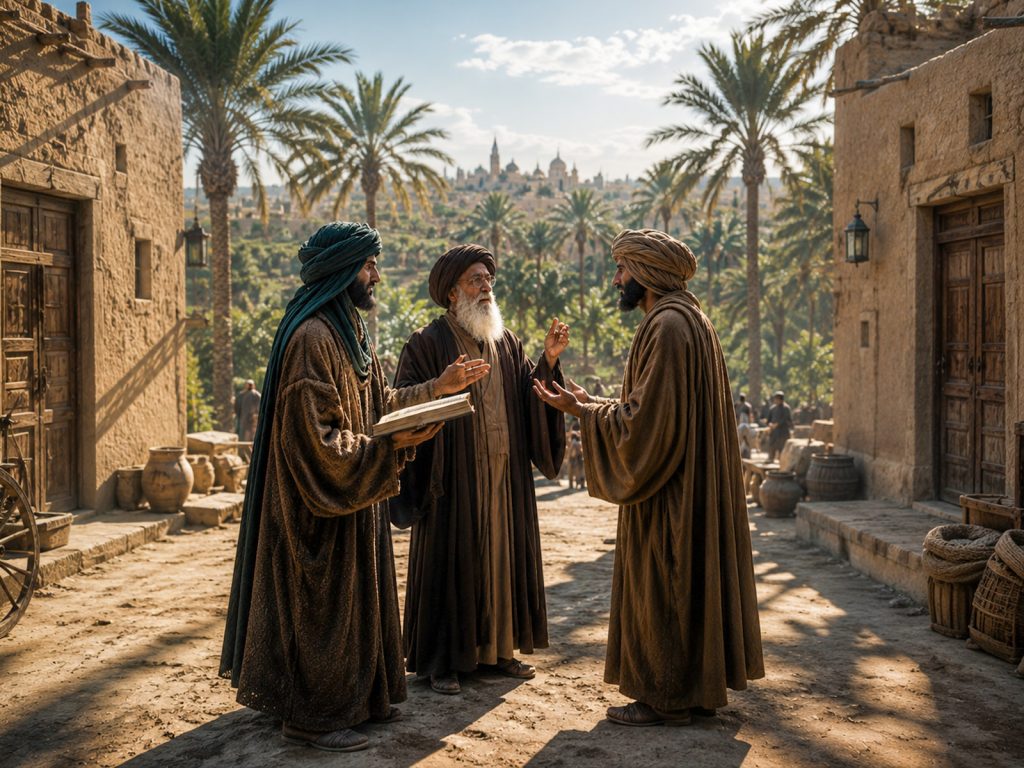

One day, Abū al-Ḥasan al-Raffāʾ[1], one of the renowned Shīʿa poets, said to Ibn Rāmīn[2], the Shāfiʿī jurist:
“O Ibn Rāmīn! When the Messenger of Allah (peace be upon him and his family) departed from Medina (for the Battle of Tabūk), did he appoint anyone in his place?”
Ibn Rāmīn replied: “Yes, he appointed ʿAlī (peace be upon him) in his place.”[3]
Al-Raffāʾ said: “Then why did he not say to the people of Medina: ‘Choose someone yourselves, for you will never go astray, nor will your community fall into misguidance.’”
Ibn Rāmīn replied: “Because the Messenger of Allah feared discord and conflict among the people.”
Al-Raffāʾ said: “And what harm would there have been if a disagreement had arisen? Surely, when he returned from his journey, he would have set it right.”
Ibn Rāmīn said: “But the action of the Messenger of Allah—appointing a deputy himself for the time of his absence—was more prudent, more fitting, and more reasonable.”
Al-Raffāʾ said: “Therefore, it follows with certainty that he must also have appointed someone to succeed him after his death.”
Ibn Rāmīn said: “No, it is not so!”
Al-Raffāʾ said: “Was not the death of the Prophet (peace be upon him and his family) more significant than his journey? The journey of this world is brief, while the journey of death is long and eternal. How then is it that at the time of his death he was unconcerned about the discord of the community and appointed no successor, yet for a worldly journey of only a few days—while he himself was alive and able to resolve any disputes—he appointed a deputy for himself?”
Confronted with the logical words of Abū al-Ḥasan al-Raffāʾ, Ibn Rāmīn was unable to respond and remained silent.[4]
From the very beginning of his mission until the time of his passing, the Messenger of Allah (peace be upon him and his family), by divine command and through various means, introduced his successor. By setting forth the criteria of leadership and demonstrating the worthiness of the Commander of the Faithful ʿAlī (peace be upon him) for this great responsibility, he prepared the ground for the continuation of his movement. The pages of history stand as living witnesses to this claim, and the existing historical records serve as firm and undeniable testimony to this truth and to his worthiness.[5]
The matter of the succession and designation of the Commander of the Faithful (peace be upon him) was so evident and clear to all that when the Messenger of Allah (peace be upon him and his family) informed the Muslims of the nearness of his passing, they asked him about all the affairs that were to be attended to after his demise—except his succession, which was already certain and beyond question for them. They inquired about his washing, his shrouding, who should perform the funeral prayer over him, where he should be buried, and other such matters[6]. Yet no one asked: “Who will lead the community after you?” Is this not because the matter of leadership had already been clarified, and the Prophet (peace be upon him and his family) had repeatedly declared it and introduced his successor to all?
The truth is that they did not ask about this matter because they knew that at Ghadīr the Messenger of Allah (peace be upon him and his family) had completed the proof and had taken the pledge of allegiance from all for the Imām.
Abundant sources and precious works such as al-Ghadīr have proven hundreds of times that the Messenger of Allah (peace be upon him and his family) fell short in no way in introducing his successor. He took the necessary measures to establish the Imamate of the Commander of the Faithful ʿAlī (peace be upon him), so that, as the Lady of the Two Worlds, al-Ṣiddīqah al-Kubrā (peace be upon her), declared, no excuse would remain for anyone[7]. Thus the people might turn toward the rightful Imām and walk the straight path by following him. Far be it that the Messenger of guidance and mercy should have neglected such a momentous matter; indeed, the shortcoming was on the part of the Muslims, who fell prey to Satan’s deception. Like the community of Moses (peace be upon him), despite all the emphasis and counsel, they were led astray by the guile of Sāmirī, gave their hearts to the world, and set aside the Household of Prophethood.
Indeed, from that day, the dust of calamity and affliction—caused by the neglect of the message and the Messenger (peace be upon him and his family)—has settled upon the body of the Islamic community until this very day, in the hope that perhaps one day the Muslims may awaken and return to his straight path.
Taken from the book Imām: The Unique of the Age, authored by Dr. Murtadā Ṭāhirī (with slight modifications and additions)
Tags: Al Madinah – Faghih Shafei – fair judgment – Ghozve Tabok – Satan's deception
Footnotes:
[1] Abū al-Ḥasan al-Raffāʾ (d. ca. 360 AH in Baghdad), one of the renowned Shīʿa poets.
[2] ʿAbd al-Wahhāb ibn Muḥammad ibn ʿUmar ibn Muḥammad al-Baghdādī al-Shāfiʿī, known as Ibn Rāmīn, a Shāfiʿī jurist, d. 430 AH.
[3] This refers to the Battle of Tabūk. In Rajab of the ninth year after Hijra, the Messenger of Allah (peace be upon him and his family) set out for war against the Romans. Before leaving Medina, he appointed the Commander of the Faithful ʿAlī (peace be upon him) as his deputy in the affairs of Medina due to the concerns and sensitivity of the circumstances. (al-Irshād, vol. 1, p. 156; Sīrah Ibn Hishām, vol. 2, p. 519)
Indeed, this practice of the Prophet (peace be upon him and his family)—appointing a deputy during his absence from Medina—can be observed and traced in all the expeditions. For further reading, you may consult “this link.”
[4] Manāqib Āl Abī Ṭālib, vol. 1, p. 258
[5] For example, the event of Yawm al-Inḏār (Ṭabarī, vol. 2, p. 320); the event of Ghadīr (al-Ghadīr, vol. 1, pp. 14–72); the event of Manzilah (Ṣaḥīḥ Muslim, vol. 15, p. 174); the event of the banner (Tārīkh al-Yaʿqūbī, vol. 2, p. 56); the event of Mulāzamat al-Ḥaqq (al-Mustadrak of al-Ḥākim, vol. 3, p. 124); the ḥadīth of Thaqalayn (Musnad Aḥmad, vol. 3, p. 14); the explicit statement of adherence to the Qur’an (al-Mustadrak of al-Ḥākim, vol. 3, p. 124); the narration of the Ark (al-Mustadrak of al-Ḥākim, vol. 2, p. 343); the narration of the mending of the sandal (Musnad Aḥmad, vol. 3, p. 33); the event of brotherhood (al-Mustadrak of al-Ḥākim, vol. 1, p. 14); the narration of unity (Shawāhid al-Tanzīl, vol. 1, p. 375); the declaration of disavowal (Musnad Aḥmad, vol. 1, p. 331)—and dozens of other historical evidences cited in both Shīʿa and Sunnī sources—all stand as parts of this claim, though detailing each of them here is not possible.
[6] Tārīkh al-Ṭabarī, vol. 1, pp. 1804–1806; Ṭaraf min al-Anbāʾ wa al-Manāqib of Sayyid ibn Ṭāwūs, p. 545, and others.
[7] al-Khiṣāl, vol. 1, p. 173