
“Unlock”
Basma Ta’ala In the days when the corona disease has spread all over the world, it is natural that some people suffer because of this disease, some people are afraid that they might get the disease, some people are sad


Basma Ta’ala In the days when the corona disease has spread all over the world, it is natural that some people suffer because of this disease, some people are afraid that they might get the disease, some people are sad

In Islamic teachings, humility is considered one of the most valuable moral virtues, and generally, people like humble individuals. Allah says in the Holy Quran: “And the servants of the Most Merciful are those who walk upon the earth with

It has been narrated by Ahmad ibn Ubaydullah ibn Khāqān, who was appointed by the Abbasid caliphs as the administrator of the endowments and alms of Qom, and who eventually became an enemy of and deviated from the Ahl al-Bayt

The text explains the authenticity of Shiʿa hadith by tracing their early compilation through companions of the Imams, especially during Imam Hassan al-Askari’s era. It highlights scholarly efforts, Imam approval of works, and preservation of teachings as an enduring Shiʿa heritage from the Imams’ time to the present.

Reflection on life’s brevity, death, and accountability through Imam Hassan al-Askari’s sermon and poems. He urges detachment from worldly illusion, remembrance of death, trust in Allah’s mercy, and preparation for the hereafter. Awareness of mortality awakens the soul, restrains vain acts, and calls humans toward repentance, humility, and sincere devotion.

One of the prominent qualities of Imam al-Askari (peace be upon him) during his 29 years of life was his attention and concern for the problems and difficulties of the people, especially the Shi’a. In this regard, historians have narrated

Abu al-Adyan, the servant of Imam al-Askari (peace be upon him), says: “I was in the service of Imam al-Askari (peace be upon him), and I used to carry His letters to various cities. One day, during the illness that
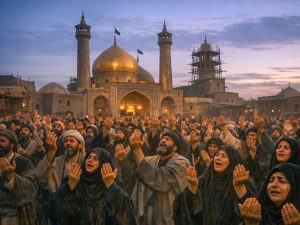
The text describes a supplication taught by Imam Hassan al-Askari during Abbasid oppression, portraying prayer as spiritual resistance. It condemns tyranny, corruption, and injustice, teaches patience and reliance on Allah when action is impossible, and ends with hope for Imam Mahdi to restore justice.

Message reflects reliance on Allah, answered prayers, and peace through remembrance. It recounts an episode where Imam Hassan al-Askari reassures a ring-maker facing punishment, leading to unexpected resolution. The text emphasizes trusting Allah, seeking help through His chosen ones, and commemorates the Imam’s martyrdom, and enduring spiritual lessons for believers.

Imam Hasan al-Askari offers a practical path to spiritual growth: God-consciousness, prayer, charity, patience, forgiveness, helping others, seeking knowledge, night prayer, and awaiting Imam Mahdi. Perfection is achieved through consistent practice of these virtues, not mystery, but sincere effort and perseverance.

Imam Hasan al-Askari teaches that lying is the key to all evils, while truthfulness is the foundation of trust, peace, and social stability. Honesty in speech, action, and promises builds strong relationships and earns divine approval, whereas dishonesty leads to disgrace, conflict, and moral collapse.

This text stresses that true Shiism is shown through moral conduct, not claims alone. Imam Hasan al-Askari urges Shiʿa to be an honor to Ahl al-Bayt through exemplary ethics, kindness, and good manners toward all, attracting others to faith rather than causing embarrassment or misjudgment.

Imam Hasan al-Askari teaches that God always welcomes supplication and no seeker leaves His door empty-handed. Delayed or altered answers are acts of divine wisdom and mercy, bringing greater benefit, forgiveness, or reward in the Hereafter. True prayer is never wasted, even when unseen.

This text reminds believers to value divine blessings, especially Wilayah—knowing and obeying the true Imam. Imam Hasan al-Askari teaches that neglecting this guidance leads to spiritual blindness. Allah’s obligations are acts of mercy, and gratitude for divine leadership shapes destiny in this world and the Hereafter.

Imam Hasan al-Askari strengthened the system of Shiʿi leadership by establishing reliance on qualified scholars during times of restriction and impending occultation. By appointing trusted representatives and encouraging emulation of pious jurists, he laid the foundation of the marjaʿiyyah system that continues to guide Shiʿa during Imam Mahdi’s occultation.

Imam Hasan al-Askari bore the heavy responsibility of introducing Imam Mahdi and preparing Shiites for the occultation. Under Abbasid surveillance, he protected his son and affirmed continuous divine guidance. Faith, steadfast belief in the Imam, and supporting fellow believers ensure salvation during occultation.

This narration highlights Imam Hasan al-Askari’s deep monotheism and awareness of the Resurrection from childhood. He taught that humans are created to know and worship Allah, not for play. His fear of accountability reflects profound spiritual insight, sincerity in worship, and consciousness of divine judgment.

Imam Hassan Askari (peace be upon him) passed away on the morning of Friday, the 8th of Rabi’ al-Awwal in the year 260 AH, during the Fajr prayer. Ibn Babawayh and others have reported that the Abbasid Caliph, al-Mu’tamid, poisoned

Imam Hassan al-Askari (peace be upon him) said: “The most pious of people is the one who refrains in the face of doubts (things about which a person does not know their law of permissibility or prohibition); the most devout

The Shiite Imams faced immense pressure throughout much of their lives, especially under the regimes of their time. Imam al-Askari (peace be upon him) was moved from Medina to Samarra during his youth, along with his father, Imam al-Hadi (peace