

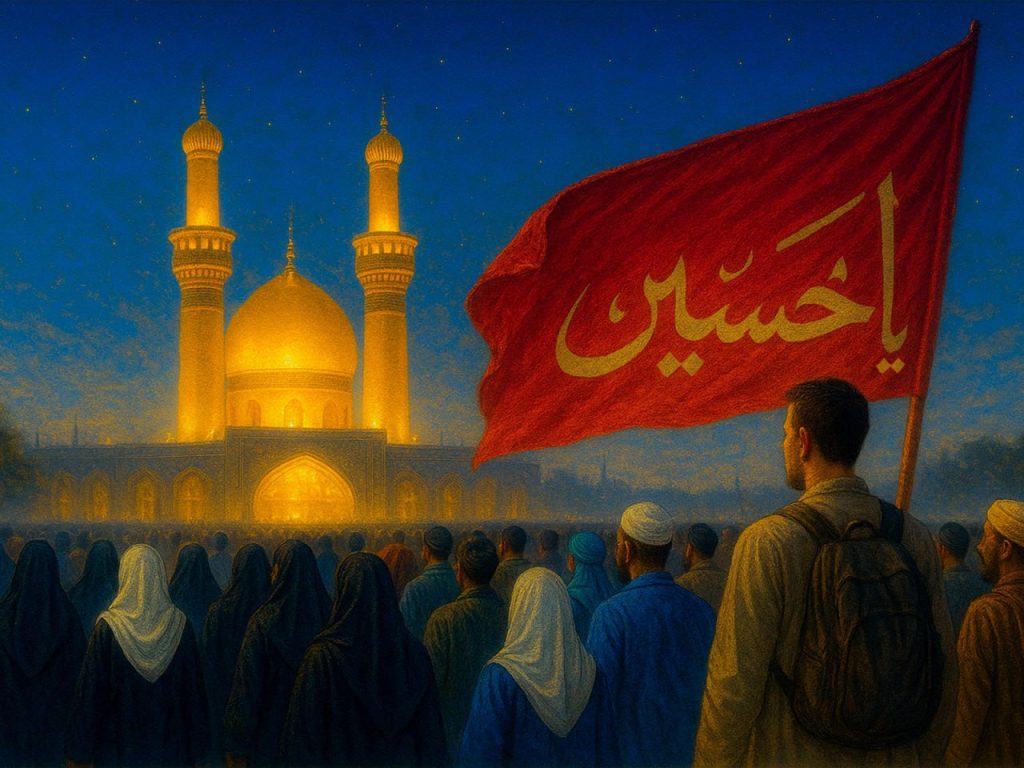

The Importance and Philosophy of Ziyārah (Visitation)
One of the recommended devotional acts in Islam is ziyārah, which literally means “visitation.” In religious culture, it refers to being present before the Prophet or the Imams (peace be upon them) or at their graves, to express love and respect for the friends of God and to magnify His symbols.
Just as visiting family and friends during their lifetime—or at their graves after death—is a sign of love, the same is true for the Prophet Muhammad (peace be upon him and his family) and the infallible Imams, who are the most beloved servants of God. Authentic traditions mention that visiting them not only shows affection but also brings abundant blessings. According to Imam al-Ridā (peace be upon him), ziyārah is an expression of loyalty to the covenant with the Imams, and those who visit with love and affirmation of their cause will be granted their intercession on the Day of Judgment.[1]
The Virtue of Visiting Imam Husayn (peace be upon him)
While visiting all the Imams is meritorious, the visitation of Imam Husayn (peace be upon him) in Karbala holds a special place. Traditions describe extraordinary rewards and spiritual benefits for his visitors, such as protection from evil and an increase in sustenance.[2]
The Arba‘een Visitation
Visiting Imam Husayn (peace be upon him) is recommended at all times, but certain occasions carry greater emphasis—such as mid-Rajab, mid-Sha‘bān, the Day of ‘Arafah, and others. Among these, the Arba‘een (the 40th day after Ashura) has always held special significance.
Historical reports tell us that Jābir ibn ‘Abdullah al-Ansārī, a close companion of the Prophet, was the first to perform the ziyārah on Arba‘een. Since then, Shi‘a have strived to reach Karbala on this day. Imam Hasan al-‘Askarī (peace be upon him) even mentioned the ziyārah of Arba‘een as one of the five distinguishing signs of a believer.[3] Imam al-Sādiq (peace be upon him) also taught a specific ziyārah text for this occasion, highlighting its importance.[4][5]
Walking as a Form of Respect
In addition to the place and time, the etiquettes (ādāb) of ziyārah are also significant. One highly recommended act is to walk toward Karbala. Walking reflects humility and reverence. Imam al-Sādiq (peace be upon him) said:
“Whoever leaves his house intending to visit the grave of Husayn ibn ‘Alī (peace be upon him), if he walks, then for every step God records one good deed, erases one sin, and elevates him one rank.”[6]
Continuity of the Arba‘een Pilgrimage
Because of these emphases, the tradition of walking to Karbala developed and gradually expanded. In particular, during Arba‘een, Shi‘a mourners and lovers of Ahl al-Bayt show solidarity with the suffering of the captives of Imam Husayn’s family—women and children—who, according to reports, returned to Karbala around this time.
Despite restrictions and oppression from tyrannical rulers throughout history, this tradition has endured. Every year, millions of Shi‘a from near and far converge on Iraq to join the immense gathering of Zuwār al-Husayn. Along the way, they remember the tragedy of Karbala, weep over the suffering of Imam Husayn (peace be upon him) and his family, and express loyalty by completing the journey on foot.
:Footnotes
[1] al-Kāfī, vol. 4, p. 567.
[2] Kāmil al-Ziyārāt, no. 151. Imam al-Bāqir (peace be upon him) said:
“Command our followers to visit the grave of Husayn (peace be upon him), for indeed his visitation increases sustenance, prolongs life, and repels calamities.”
[3] Kitāb al-Mazār (al-Mufīd), p. 53.
[4] Qabasāt min ‘Ilm al-Rijāl, vol. 3, p. 656.
[5] The well-known Ziyārah of Arba‘een begins with: “Peace be upon the friend of God and His beloved; peace be upon the close one of God and His chosen…”
[6] Kāmil al-Ziyārāt, p. 132.