


Question:
What is Shi‘ism (Tashayyu‘) and what do the Shi‘a believe?
Introduction
To understand Shi‘ism, one must first know Islam—the final divine law revealed by God through the Prophet Muhammad (peace and blessings be upon him and his family).
Islam: Core Beliefs (Brief)
Islam is faith in the One God. Its foundations include belief in all divinely sent messengers and their infallibility, faith in the Qur’an (the final heavenly book), acting upon Islamic rulings, and belief in the Hereafter—resurrection, judgment, reward and punishment.
“Shi‘a”: Lexical and Technical Meanings
Lexically, shi‘a means “follower/partisan.”[i]
Technically, it refers to those Muslims who believe that after the Prophet Muhammad, Imam ‘Alī b. Abī Ṭālib (peace be upon him) was divinely appointed as the immediate Imam and successor.
The Prophet used the term “Shi‘a” for the followers of ‘Alī and the Ahl al-Bayt. In explaining “Indeed, those who believe and do righteous deeds—they are the best of creation” (Q 98:7), he said to ‘Alī: “You and your Shi‘a are the best of creation.”[ii][iii] He also swore that ‘Alī and his Shi‘a will be the successful ones on the Day of Resurrection.[iv] Imam ‘Alī said: “My intimate (the Prophet) told me: you and your Shi‘a will come to God pleased and pleasing, while your enemies come angered and constrained.”[v][vi]
Shi‘i Doctrinal Hallmarks
Shi‘ism holds that while prophethood ended with Muhammad, the community was not left unguided: twelve divinely appointed Imams were designated as his successors.[vii] The first is Imam ‘Alī, whose leadership the Prophet repeatedly announced—most publicly at Ghadīr—after which the religion was perfected.[viii]
Thus, a Shi‘a is one who believes in the twelve Imams, and in heart, speech, and action obeys the Prophet and his purified Household. By the Qur’an and the Prophet’s statements, the Ahl al-Bayt are infallible (free from error).[ix] Alongside the Prophet and the twelve Imams, Lady Fāṭimah (peace be upon her) is also included among the purified Ahl al-Bayt.
Qur’an and ‘Itrah (Ahl al-Bayt)
The Qur’an is God’s word revealed to the Prophet. Shi‘a believe that the sources of Islamic guidance are the Qur’an and the ‘Itra (the Prophet’s Household). While the Qur’an contains comprehensive guidance, its true, complete interpretation lies with the Ahl al-Bayt, who are divinely taught and the authentic expositors of revelation. In the Hadith of al-Thaqalayn, the Prophet declared the Qur’an and his Household together to be the twin means of salvation; holding fast to both prevents misguidance.[x]
Mahdism (Belief in the Awaited Imam)
A core Shi‘i tenet is that a living Imam exists in every age. The Imams are twelve: the first is ‘Alī; the last is Imam al-Mahdi (may God hasten his relief), son of Imam al-Ḥasan al-‘Askarī, who since 260 AH lives in occultation—present on earth yet not publicly identified. By God’s certain promise, he will reappear when injustice fills the world, to establish universal justice and peace.
This belief nurtures hope, energizes constructive effort, and combats despair, as believers await the divinely promised relief.
Worship and Devotional Practice
Beyond doctrine, a Shi‘a strives to follow the Qur’an and Ahl al-Bayt in action, character, and lifestyle—upholding the obligations and avoiding prohibitions. Prayer, fasting, ḥajj, and zakāt are pillars of devotion, and wilāyah (allegiance to the Imams) is the condition of their full acceptance.
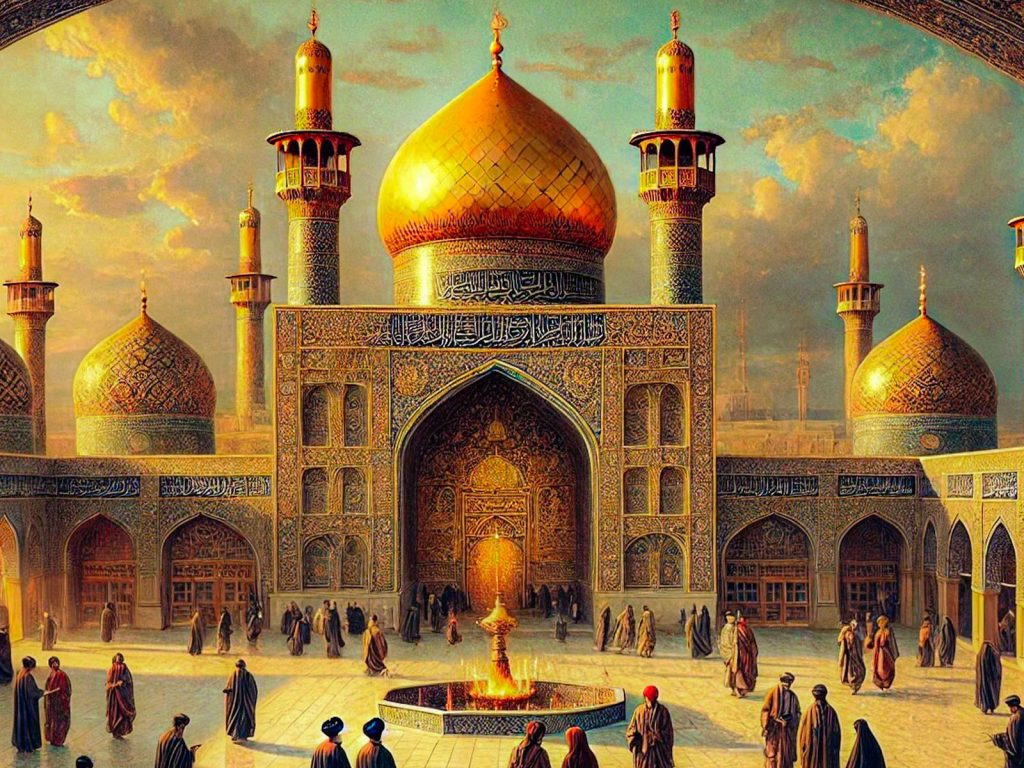
Shi‘a cherish pilgrimage to the Sacred House and the Prophet’s Mosque and also visit the shrines of the Imams, seeking God’s grace through them as sanctioned intercessors by His leave. They honor Ramaḍān—fasting, avoiding sins, reciting the Qur’an—and give special care to the Nights of Qadr (19th, 21st, 23rd).
Regular Qur’an recitation is encouraged from childhood so that believers grow attached to its guidance throughout life.
Social and Ethical Dimensions
Among the greatest acts is love and loyalty to the Prophet’s Household—the very “reward” God commanded for the Prophet’s mission is manifest love (mawadda) for his near kin.[xi] Shi‘a therefore hold gatherings to recall their virtues, seek their intercession, and keep their memory alive—while also dissociating from their enemies in a principled, God-centered way.
Consequently, Shi‘a share in the Ahl al-Bayt’s joys and sorrows; they commemorate the martyrdoms—especially Imam Ḥusayn (peace be upon him) in Muḥarram and on ‘Āshūrā—through sermons and elegies that also teach religion and strengthen faith.
Ethically, Shi‘ism emphasizes truthfulness, trustworthiness, and beautiful character—the very virtues the Prophet came to perfect—and seeks to embody them by modeling the Imams.[xii]
Conclusion
Shi‘ism is the continuation of Islam as taught by the Seal of Prophets. A Shi‘a believes in twelve God-appointed, infallible Imams, and strives to live by their guidance—hopeful for the fulfillment of God’s promise and the appearance of the Riser from the Prophet’s Household to establish justice across the earth.
Footnotes:
[i] Mufradāt Alfāẓ al-Qur’ān, p. 470; Kitāb al-‘Ayn, vol. 2, p. 191.
[ii] Qur’an 98:7 (al-Bayyinah).
[iii] Al-Ṭabarī, Tafsīr, vol. 30, p. 265; Niẓām Durar al-Simṭayn, p. 92; al-Ṣawāʿiq al-Muḥriqah, p. 161.
[iv] Al-Suyūṭī, al-Durr al-Manthūr, vol. 6, p. 379; Tārīkh Madīnat Dimashq, vol. 42, p. 371; Mukhtaṣar Tārīkh Dimashq, vol. 18, p. 14.
[v] Kanz al-‘Ummāl, vol. 13, p. 156, ḥadīth 36483; Shiblānji, Nūr al-Abṣār, p. 78; al-Ṣawāʿiq al-Muḥriqah, p. 161; Ibn al-Athīr, al-Nihāyah, vol. 4, p. 106; al-Fusūl al-Muhimmah, p. 123; Niẓām Durar al-Simṭayn, p. 92.
[vi] Khalīl means an intimate, single-hearted friend.
[vii] Al-Ṭūsī, al-Amālī, majlis 11, p. 292; Kifāyat al-Athar, ch. on the Twelve Imams; al-Ḥamawī, Farā’id al-Simṭayn, vol. 2, p. 320.
[viii] Qur’an 5:3 (“Today I have perfected your religion for you…”).
[ix] Qur’an 33:33 (Āyat al-Taṭhīr).
[x] Al-Kāfī, vol. 1, p. 294; also Ṣaḥīḥ Muslim, Book of Virtues of the Companions, hadith 2408.
[xi] Qur’an 42:23.
[xii] al-Kāfī, vol. 2, pp. 636–637, Bāb al-Wara‘.