


Question:
Is the obligation of ḥijāb for women mentioned in the Qur’an?
Introduction
Divine religions have consistently emphasized women’s modest dress. In Islam, due to the distinct natures of men and women, God prescribes different guidelines for each. In Islamic law, the woman’s prescribed covering is commonly termed ḥijāb.
The Meaning of Ḥijāb
a) Lexical meaning. In Arabic, ḥijāb primarily means (1) a barrier or partition between two things,[1] and (2) covering or concealment.[2]
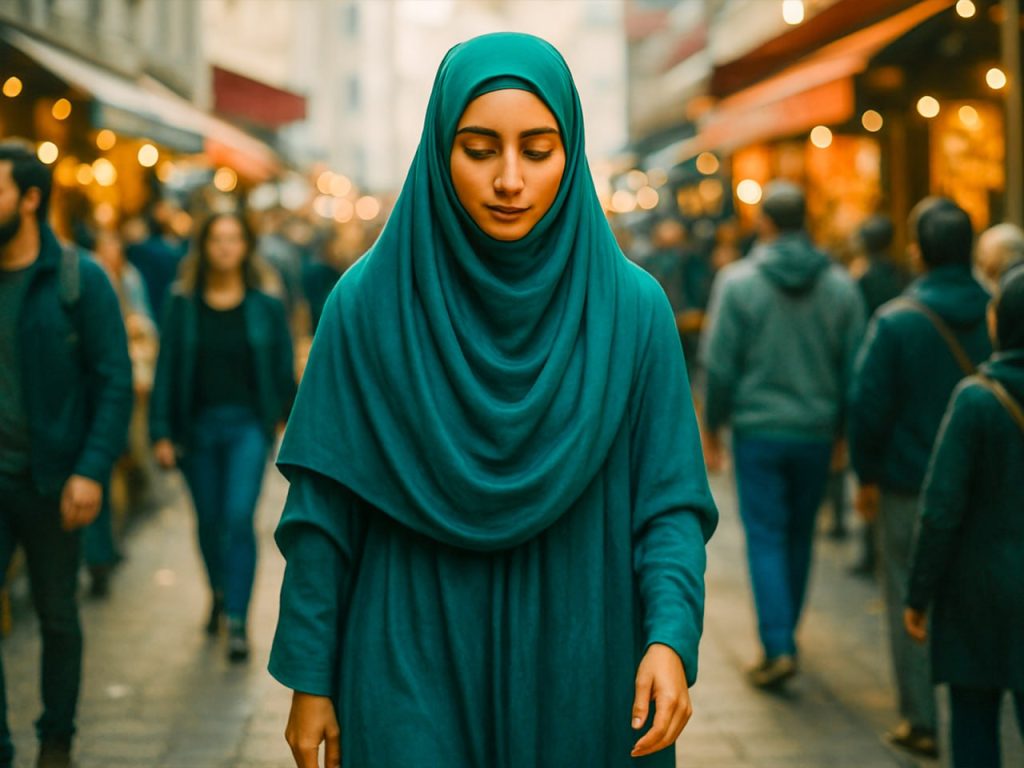
b) Technical (religious) meaning. In Islamic usage, ḥijāb refers to the specific covering for women that prevents non-maḥram men from viewing their hair and body.
Qur’anic Verses on Women’s Ḥijāb
1) Al-Aḥzāb (33):59
“O Prophet, tell your wives and your daughters and the women of the believers to draw their outer garments (jalābīb) over themselves. That is more suitable so that they may be recognized [as chaste] and not harmed.”
The verse uses yudnīna ‘alayhinna min jalābībihinna. Jalābīb is the plural of jilbāb.
Jilbāb. From the aggregate of linguistic and exegetical studies, jilbāb is an all-encompassing outer garment that covers not only the hair, neckline, and chest, but even extends lower to fully conceal the body.[3] The verse instructs believing women to cast (not gather upward) their outer garments over themselves so they are known for modesty and thus not harassed or harmed.[4]
2) Al-Nūr (24):31
“And tell the believing women … not to display their adornment except what [ordinarily] appears thereof; and let them draw their headcovers (khumur) over their bosoms.”
The phrase wal-yaḍribna bi-khumurihinna ‘alā juyūbihinna uses khumur, plural of khimār—a headcover worn by women (essentially a scarf or veil).[5] The verse commands women to draw their khimār over the juyūb (neckline/chest openings), and to refrain from displaying adornment, save the limited exceptions specified.
Historical note. Both the wording of these verses (“jalābībihinna” and “khumurihinna”) and historical reports indicate that Muslim women already used khimār (head/neck covering) and jilbāb (outer garment). The Qur’an’s injunction refined their use: in addition to covering the hair, women were to fully cover the neck, chest, and even lower parts properly.[6]
Beyond Dress: The Qur’an’s Emphasis on Chastity (‘iffah)
Alongside legal boundaries of dress, the Qur’an consistently commends ḥayā’ (modesty) and ‘iffah (chastity). It instructs:
-
Lowering the gaze and avoiding illicit looks (addressed to women—and emphatically to men as well).[7]
-
Guarded speech: women should not speak in a soft, alluring, or provocative manner with non-maḥrams.[8]
-
Dignified conduct: comportment should be modest and not draw improper attention.[9]
Ḥijāb in Earlier Faith Traditions
Modesty norms are not unique to Islam. Sacred texts of previous traditions also include teachings on chastity and female covering; even today, some Jewish and Christian communities maintain head-covering practices for women.[10]
An Important Note
Islam is grounded in the inseparable twin authorities: the Qur’an and the Ahl al-Bayt.[11] Many acts of worship and rulings are not exhaustively detailed in the Qur’an alone. For example, prayer is commanded in the Qur’an, but its rak‘ahs and many particulars come from the Prophet and the Imams. Ḥijāb is similar: while the Qur’an provides the principle and key directives, numerous details (e.g., specifics about adornment, boundaries, and practice) are clarified through the teachings of the Ma‘ṣūmīn (peace be upon them).
Tags
Qur’anic verses on women’s ḥijāb – Tafsīr of 33:59 – Tafsīr of 24:31 – Ḥijāb in previous revelations – Chastity and modesty in Islam – Lexical and technical meanings of ḥijāb – Role of Ahl al-Bayt in explaining details
Footnotes
[1] Mufradāt Alfāẓ al-Qur’ān, p. 219.
[2] Lisān al-‘Arab, vol. 3, p. 50.
[3] Kitāb al-‘Ayn, vol. 6, p. 132.
[4] Tafsīr al-Qummī, vol. 2, p. 196.
[5] Mufradāt Alfāẓ al-Qur’ān, p. 298.
[6] Al-Mufīd, al-Irshād, vol. 1, p. 57.
[7] Qur’an 24:31.
[8] Qur’an 33:32.
[9] Qur’an 24:31.
[10] For general orientation, see: “Head covering for Jewish women,” Wikipedia.
[11] Biṣā’ir al-Darajāt, vol. 1, p. 413.