

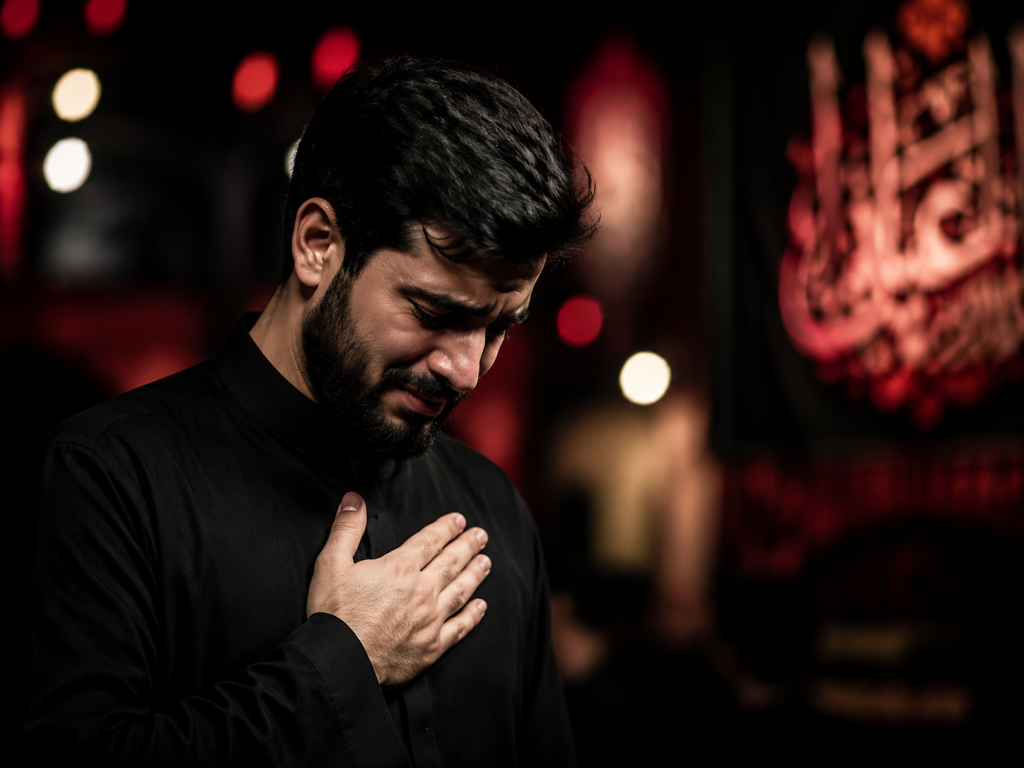

Introduction: What Is Mourning (‘Azā-dārī)?
Within all human beings lies a natural inclination toward goodness. We love the honest and upright, and that love shows itself in our feelings and behavior: we rejoice at their joy and grieve at their sorrow. No one can truly claim love while remaining indifferent to the beloved’s condition.
It is self-evident that a person mourns the loss of loved ones. The more beloved and deserving the deceased is, the heavier the grief. Anyone who has lost a parent knows this well. Such grief is not merely inward; it manifests outwardly—one expression being tears and communal mourning.
Mourning refers to actions and ceremonies arising from grief, performed in customary ways—often collectively—to express sorrow for the departed.
The Nature and Function of Mourning for the Ahl al-Bayt (peace be upon them)
The higher the status of the one lost, the greater the weight of mourning. Some in this world have rights over us even more than our parents: those who dedicated their lives to God’s worship and to guiding humanity—the prophets and their successors.
The Prophet Muhammad (peace be upon him and his family) is the final messenger, and after him his pure Household are the guides and Imams. They endured hardships to lead us to the straight path and eternal felicity; thus they have immense rights over us, and following them is the key to salvation.
Remarkably, the Prophet asked no reward for his arduous mission except love toward his close kin: “Say, I ask of you no reward for it, except love for [my] near relatives.”[1]
Here the Qur’an uses mawadda (manifest love), not merely inner affection. One practical expression of such love is mourning for them in their tragedies. Mourning is therefore both a sign of love and a means of drawing nearer to the Prophet’s Household. A Shi‘a Muslim strives, through mourning, to strengthen his heart’s bond with them—at all times and places.
Our Motives for Mourning the Ahl al-Bayt
On the anniversaries of the Imams’ martyrdoms, grief is renewed. Remembering their oppression and loneliness pains the hearts of their lovers; thus gatherings are held to commemorate and keep their names alive. The Imams themselves encouraged such assemblies and prayed for those who revive their cause.[2]
Mourning also deepens our love and knowledge of them—an invaluable blessing that pleases God and advances us on the path of servitude.
The Special Distinction of Mourning Imam Husayn (peace be upon him)
All the Imams were oppressed and none died a natural death; all were martyred.[3] Yet the tragedy of Imam Husayn in Karbala is uniquely momentous—one of the gravest calamities in human history. Its pain defies expression. Imam al-Ridā (peace be upon him) said: “Our eyelids are wounded from weeping over his calamity.”[4]
God greatly emphasized weeping and mourning for Husayn,[5] and the Imams, with the advent of Muharram, held mourning gatherings[6] and strongly urged their Shi‘a to do the same.[7] Numerous traditions mention the immense merits and blessings of holding gatherings, recounting the tragedy, and weeping for him;[8] hence this living tradition has endured throughout history and is renewed every Muharram.[9]
Social Functions and Effects of Mourning
Mourning gatherings are not unique to Islam; followers of all revealed religions grieve for their leaders in various ways.[10]
Each year—especially in Muharram—devotees of Abā ‘Abdillāh (Imam Husayn) keep his memory alive with tears, black attire, elegies, chest-beating, processions, banners, offerings, and more. Such programs increase love for the Ahl al-Bayt and transmit it to future generations. Sermons delivered in these gatherings recount their virtues and raise public understanding of the true Islam—thus strengthening people’s faith and knowledge.
Another custom is feeding the mourners (iṭ‘ām), for which great rewards are promised.[11] Hosts often serve refreshments and blessed meals in Imam Husayn’s name, sometimes on a community-wide scale.
We Shi‘a mourn our Imams because we love them and owe our worldly and eternal felicity to their guidance. True love means rejoicing in their joy and grieving in their sorrow—especially for the singular tragedy of Imam Husayn, whose mourning has been emphatically encouraged and remains a beacon of guidance until the Day of Resurrection.
Footnotes:
[1] Qur’an 42:23 (al-Shūrā).
[2] Kāmil al-Ziyārāt, ch. 32 (Thawāb man baka ‘alā al-Husayn). Imam al-Ṣādiq (peace be upon him) said to Masma‘, a known mourner for Husayn: “May God have mercy on your tears… You will see at your death my forefathers present, recommending you to the Angel of Death, who will be gentler with you than a caring mother.” Also: Wasā’il al-Shi‘a, vol. 14, p. 501—Imam al-Ṣādiq said to al-Fuḍayl: “I love those gatherings. Revive our affair. May God have mercy on whoever revives our affair… Whoever remembers us—or we are remembered in his presence—and a tear as small as a fly’s wing flows from his eye, God will forgive his sins, even if like the foam of the sea.”
[3] Kifāyat al-Athar, p. 162—Imam al-Hasan (peace be upon him): “There is none among us but that he is either killed or poisoned.”
[4] Manāqib Āl Abī Ṭālib, vol. 4, p. 86—Imam al-Ridā describes the calamities of Muharram and the wound it left on Ahl al-Bayt.
[5] See Biḥār al-Anwār (Beirut ed.), vol. 44, p. 245, ch. 30.
[6] Report of Sufyān b. Muṣ‘ab al-‘Abdī: Imam al-Ṣādiq invited Umm Farwah to hear elegies for her grandfather; when the lament began, the women cried and the Imam ordered the door closed (to avoid hostile attention).
[7] Instruction of Imam al-Bāqir (peace be upon him) for those unable to visit on ‘Āshūrā’: hold mourning at home, weep, command one’s household to weep, and console each other—promising great reward for doing so.
[8] ‘Uyūn Akhbār al-Riḍā, vol. 1, p. 299—Imam al-Ridā: “If you must weep, then weep for Husayn… he was slaughtered like a ram.” Amālī al-Ṭūsī, majlis 6—Imam al-Ṣādiq: “All lamentation and weeping is disliked except over Husayn.”
[9] Rawḍat al-Wā‘iẓīn, vol. 1, p. 169—Imam al-Ridā: When Muharram began, my father was never seen smiling; on the tenth, it was his day of deepest grief and tears.
[10] For examples of mourning customs among followers of other revealed religions, see [reference to be added].
[11] Majma‘ al-Baḥrayn, vol. 3, p. 406—In a supplication, God tells Moses He favored the Ummah of Muhammad with ten traits, including ‘Āshūrā: weeping and making oneself weep, elegy and mourning for the offspring of al-Muṣṭafā. Whoever spends of his wealth out of love for the Prophet’s grandson receives multiplied reward and forgiveness.