

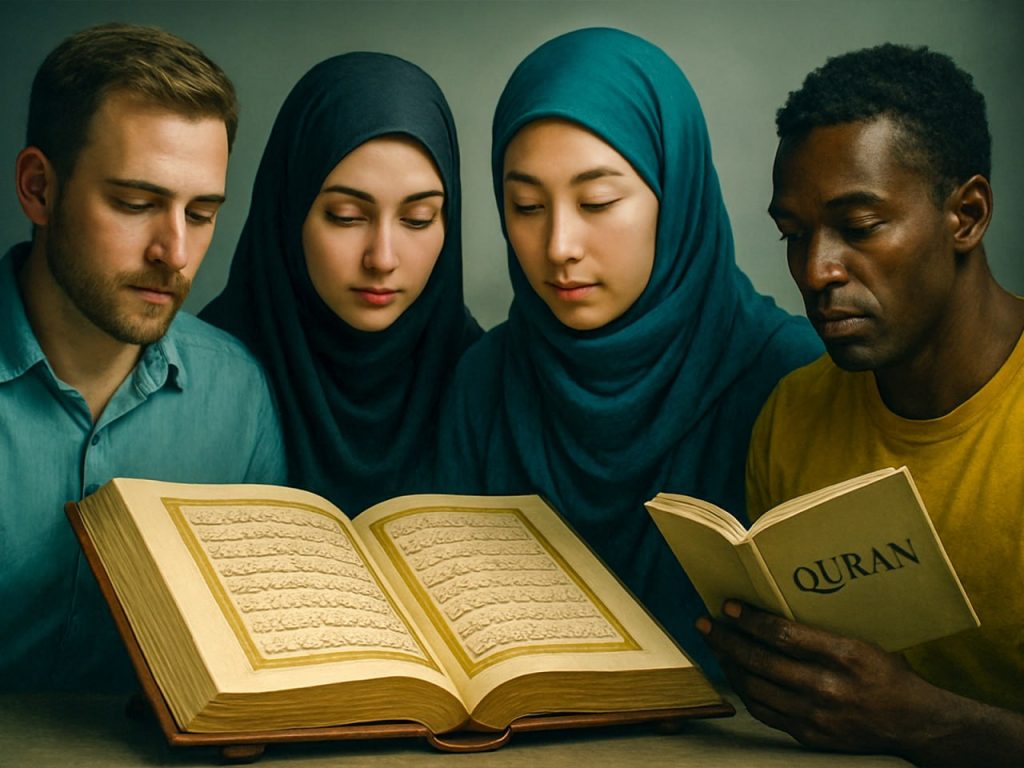

The Quran was revealed in Arabic. How can it be made accessible and beneficial for all people in the world?
Among the most important means of human communication are speech and writing. For any message—whether spoken or written—to be comprehensible to human beings, it must necessarily be expressed in a human language. God, in sending His prophets (peace be upon them) and conveying His messages, used the specific languages of different peoples and eras; that is, every divine prophet spoke the language of the people to whom he was sent, and their heavenly scriptures were in that very language.[1] The Quran, like any other book, is no exception to this rule. Its first audience was the Holy Prophet of Islam (peace be upon him and his family) and the Arabic-speaking people of the Arabian Peninsula; therefore, it is natural that the Quran was revealed in Arabic. The Quran itself declares that it speaks in clear and eloquent Arabic.[2]
But does the writing or revelation of a book in a particular language limit its audience only to the people of that language or those familiar with it, or can it also be beneficial for other nations?
Consider this example:
Avicenna (Ibn Sina), the Persian philosopher whose fame spread across the world, wrote a book on medicine in Arabic titled Al-Qanun fi al-Tibb (The Canon of Medicine). It is said that this book was translated into multiple languages and was taught in European scientific centers for nearly 700 years.[3]
Is it reasonable for physicians around the world to claim that, since this book was written in Arabic, it is useful only for Arabic speakers? Certainly not. Every medical scholar who wished to benefit from it either translated the book or relied on its translations to enhance their knowledge. In other words, the Arabic language of the book was never an obstacle for non-Arabs to access its concepts.
Now, when it comes to the Quran—a divine book that claims to be a guide for humanity on the path to salvation—anyone seeking to study its concepts will turn to it and make use of its translations.
The Quran itself introduces all of humanity as its audience and states that it has been revealed for everyone. For the sake of brevity, only one example of such verses will be mentioned:
“Blessed is He who sent down the Criterion upon His servant, that he may be a warner to all the worlds.”[4]
In conclusion, it must be said that the Arabic language is among the most powerful and influential languages. Its conciseness, eloquence, clarity, linguistic precision, and rhetorical beauty place it among the finest languages of the world.[5] The Quran claims to contain the most important messages for all humanity until the Day of Resurrection, and it has employed this language as the medium for conveying its concepts and meanings.
:Footnotes
[1] “And We did not send any messenger except [speaking] in the language of his people, so that he might make [the message] clear to them.” (Quran, Surah Ibrahim 14:4).
[2] “In a clear Arabic tongue.” (Quran, Surah Ash-Shu‘ara 26:195).
[3] The Canon of Medicine – Wikipedia.
[4] “Blessed is He who sent down the Criterion upon His servant, that he may be a warner to all the worlds.” (Quran, Surah Al-Furqan 25:1).
[5] Philip Khuri Hitti, History of the Arabs, Macmillan International Higher Education, 2002.