

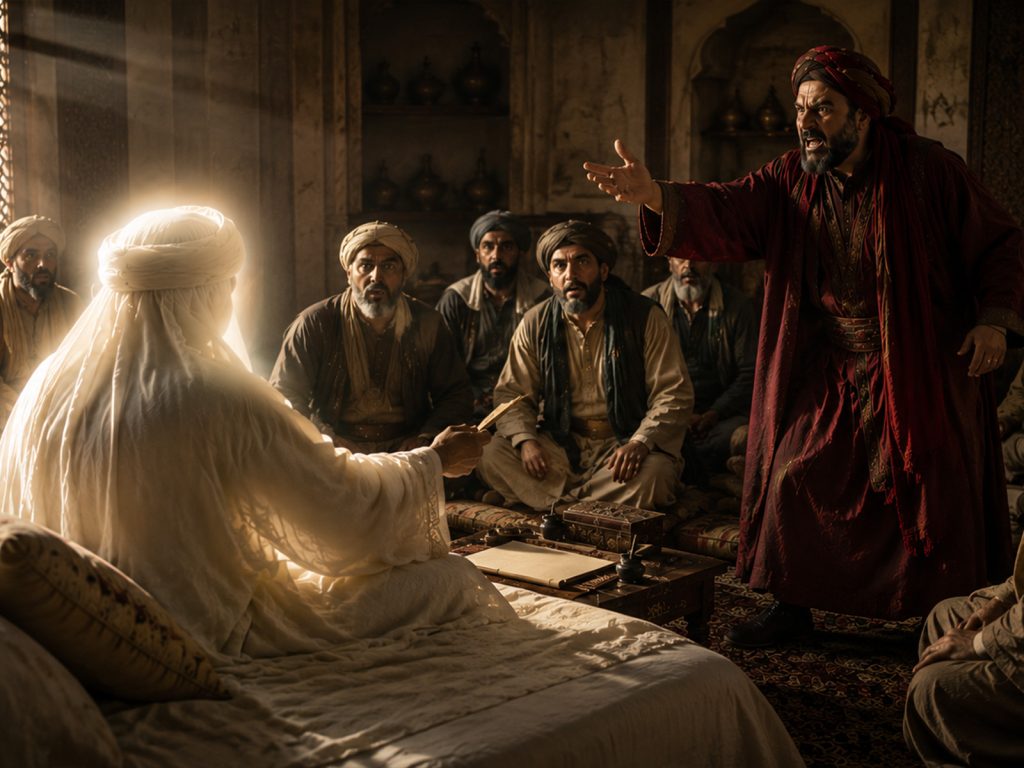

The final days of the life of the Noble Prophet (peace be upon him and his family) represent one of the most delicate and critical chapters in the history of Islam. During those days, Islam and the Muslims endured painful hours. The open opposition of some companions and their refusal to join the army of Usāmah indicated a series of covert activities and serious decisions.
At that moment, the Messenger of Allah (peace be upon him and his family), with a high fever, entered the mosque and stood by the pulpit. Raising his voice so that it could be heard from outside the mosque, he addressed the people: “O people! The fire of sedition has been kindled, and turmoil has arisen like the dark patches of the night. You have no means to oppose me. I have made lawful nothing except what the Qur’an has made lawful, and I have forbidden nothing except what the Qur’an has forbidden.”[1]
This statement reflects the profound concern of the Prophet (peace be upon him and his family) for the future and the fate of Islam after his passing. Indeed, what is meant by the fire that “has been kindled”? Is it not the fire of sedition and division that lay in wait for the Muslims, which flared up after the passing of the Messenger of Allah (peace be upon him and his family), spreading its flames—and even now, its embers have not been extinguished?
As narrated by a number of Sunni and Shīʿa hadith scholars and historians, and classified as authentic according to the science of hadith, during these days, when the leaders of the companions came to visit, the Messenger of Allah (peace be upon him and his family) lowered his head for a moment in thought, then addressed them: “Bring me paper and ink so that I may write for you something after which you will not go astray.”[2][3]
At that moment, the second Caliph broke the silence of the gathering and said: “The illness has overcome the Prophet; the Qur’an is with you, the heavenly Book—it is sufficient for us.”[4]
At that moment, a discussion arose among those present regarding the opinion of the Caliph. Some opposed him, insisting that the command of the Messenger of Allah (peace be upon him and his family) must be carried out: “Go and bring pen and paper so that what he intends may be written.” Yet others sided with the Caliph and prevented the pen and ink from being brought. The Prophet (peace be upon him and his family), deeply distressed by their disagreement and audacious words, said: “Rise and leave the house…”
Ibn ʿAbbās, the renowned scholar of Islam, with tears rolling down his cheeks like pearls, said: “What a painful Thursday that was, when the Prophet said: ‘Bring me pen and paper…’”[5] He then added: “The greatest calamity for Islam was that the disagreement and disputation among a group of companions prevented the Prophet from writing the letter he intended.”[6]
Now, since the Noble Prophet (peace be upon him and his family) was unable to dictate such a letter, can one, based on the available and certain indications, infer what he intended to convey in that letter?
The answer to this question is clear if we reflect carefully. Regarding the letter he intended to write, the Prophet (peace be upon him and his family) said: “I am writing this letter so that you do not go astray after me.” Moreover, in the ḥadīth of Thaqalayn[7], he expressed precisely the same statement, explaining that adherence to the Qur’an and his Ahl al-Bayt ensures that one will never go astray.[8]
By considering the words of these two ḥadīths and the clear similarity between them, can we not reasonably infer that the Prophet (peace be upon him and his family), in requesting pen and paper, intended to write the essence of the ḥadīth of Thaqalayn, or perhaps something even beyond what the ḥadīth of Thaqalayn conveys—that is, to affirm the authority and succession of his immediate successor?
Thus, when some, in an attempt to make amends for their earlier misconduct, offered: “Shall we bring pen and paper?” his countenance flamed with anger, and he became deeply upset, saying: “After all that discussion, you now wish to bring pen and paper? I only recommend that you treat my Ahl al-Bayt with kindness.” After saying this, he turned his face away from those present, and all of them—except ʿAlī (peace be upon him), ʿAbbās, and Faḍl—rose and dispersed.[9]
On the other hand, the open opposition of some companions, although it prevented the Noble Prophet (peace be upon him and his family) from writing the letter, did not stop him from conveying his intent by other means while the pain and distress of severe illness weighed upon him. Ibn Ḥajar al-ʿAsqalānī (one of the eminent Sunni scholars) says: “One day during his illness, while his companions were gathered around his bedside, the Prophet turned to them and said: ‘O people! My appointed time has come, and very soon I shall depart from among you. Be aware, I leave among you the Book of Allah and my Ahl al-Bayt.’ Then he took the hand of ʿAlī and raised it, saying: ‘ʿAlī is with the Qur’an, and the Qur’an is with ʿAlī; never shall the two be separated until the Day of Resurrection.’”[10]
Indeed, prior to his illness, the Messenger of Allah (peace be upon him and his family) had, on various occasions, expressed the ḥadīth of Thaqalayn in different words, drawing the attention of the people to the importance of the Qur’an and his Ahl al-Bayt. Yet, when he again emphasized the inseparability of the Book and the Ahl al-Bayt while on his sickbed, in the presence of those very individuals who had opposed the writing of his letter, it can be inferred that the purpose of these repetitions was to compensate for the letter that he had been unable to dictate…
Truly, the Prophet of Mercy, even in the final moments of his life, looked toward the future of the Islamic community and carried in his heart the concern for the guidance of his nation…
Taken from the book Eternal Radiance (Forugh-e Abadiyat), authored by Āyat Allāh Jaʿfar Subḥānī
Footnotes:
[1] Sīrah Ibn Hishām, vol. 2, p. 654; Ṭabaqāt al-Kubrā, vol. 2, p. 216
[2] “Bring me pen and paper so that I may write a document for you, after which you will not go astray.”
[3] Clearly, the intent was that he would dictate the letter and one of his secretaries would write it; otherwise, the Prophet of Islam never held a pen or wrote anything until the last moment of his life.
[4] Certainly, such an offensive and improper statement from any personality could never be pardoned, for the Prophet, according to the Qur’an, is protected from all error and speaks only through revelation. Therefore, some Sunni authorities, when quoting the Caliph’s words, refrained from mentioning his name to preserve his status (e.g., Ṣaḥīḥ Muslim, vol. 1, p. 14; Musnad Aḥmad, vol. 1, p. 355), while others offered apparent excuses to justify opposition to the Caliph (Kanz al-ʿUmmāl, vol. 3, p. 138; Ṭabaqāt al-Kubrā, vol. 2, p. 244).
[5] Musnad Aḥmad, vol. 1, p. 355
[6] Ṣaḥīḥ al-Bukhārī, vol. 1, p. 22 & vol. 2, p. 14; Ṣaḥīḥ Muslim, vol. 2, p. 14; Musnad Aḥmad, vol. 1, p. 325; Ṭabaqāt al-Kubrā, vol. 2, p. 244
[7] The ḥadīth of Thaqalayn is unanimously agreed upon by Sunni and Shīʿa scholars. It has been transmitted through more than sixty chains from the companions of the Prophet (peace be upon him and his family). For example, Ibn Ḥajar al-ʿAsqalānī writes: “The Prophet drew people’s attention to the inseparability of the Book and the Ahl al-Bayt on various occasions—on the Day of ʿArafah, the Day of Ghadīr, after returning from Ṭā’if, and even on his sickbed.” (Ṣawāʿiq al-Muḥriqah, p. 136)
[8] “I leave among you two precious things; so long as you hold fast to them, you will never go astray. These two precious things are the Book of God (the Qur’an) and my Ahl al-Bayt.”
[9] Biḥār al-Anwār, vol. 22, p. 469, citing al-Irshād and Aʿlām al-Warā
[10] Ṣawāʿiq al-Muḥriqah, ch. 9, p. 57; Kashf al-Ghummah, p. 43